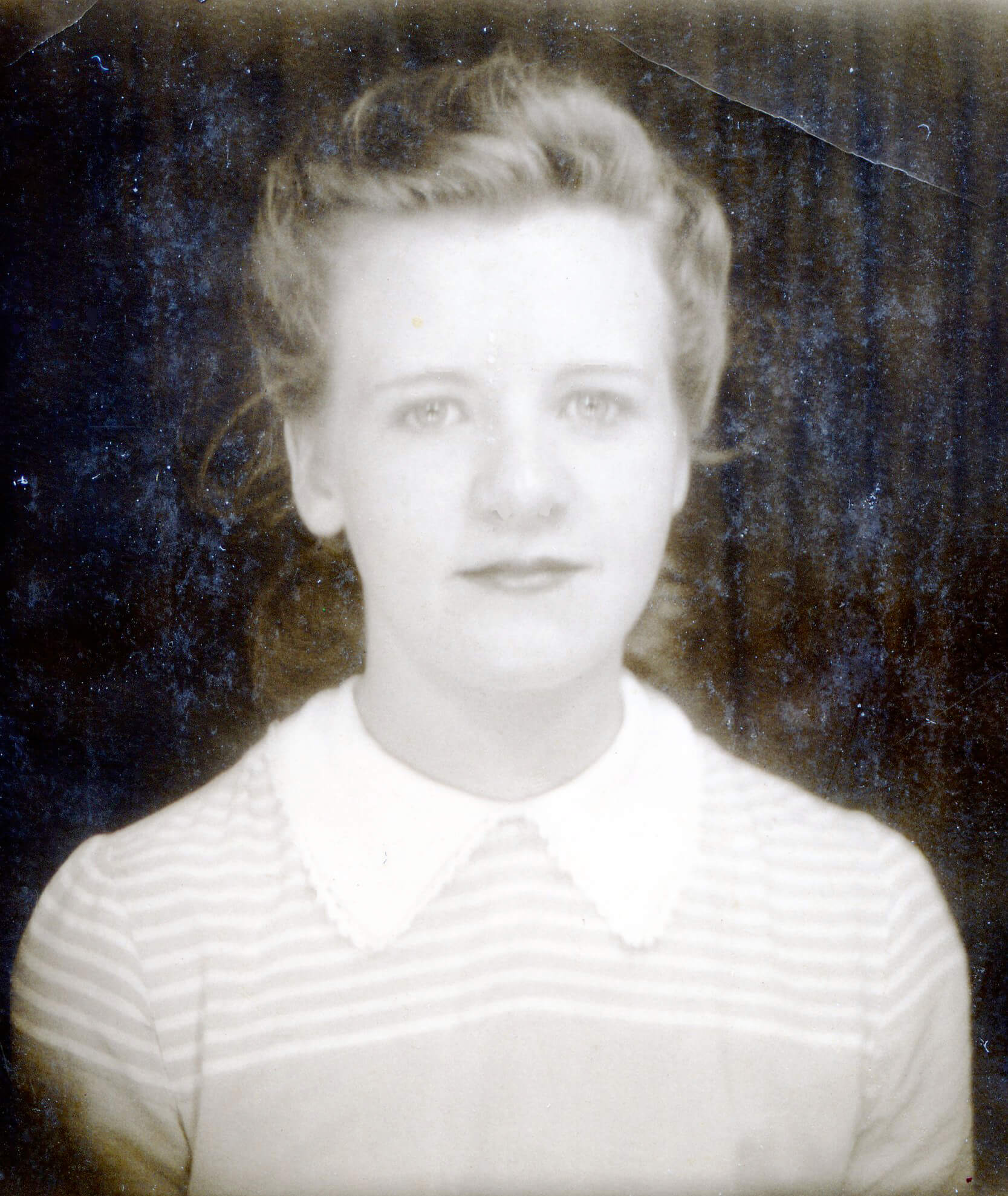
My mother, Alzada Estes Weaver Cross, daughter of Susan Gifford Weaver, was born in 1926, 55 years after the birth of her namesake, her grandmother (my great-grandmother), Alzada Estes Gifford.
Sadly, the two Alzadas never met. Grandmother Alzada died at age 51 in 1922, four years before my mother Alzada was born. I wish my grandmother Susan, whom I called Nana, had told me stories about her mother, Alzada, but I don’t have a single memory.
Growing up, Alzada regularly visited the cemetery with Nana to pay her solemn respects at Grandmother Alzada’s gravesite, and she often saw her grandmother’s beautiful, subtly-smiling face in the one treasured photo that exists – and yet, there was no denying that my mom, Alzada Estes Weaver, positively HATED her first name.
But, what does it mean, exactly? Because of the name’s rarity, I couldn’t find a reliable source of its meaning, and the U.S. Social Security Administration recorded only 337 babies named Alzada during the 135 years between 1880 and 2015.
In Spanish, alzada (pronounced all-ZAH-dah) is the feminine form of the adjective alzado, meaning “height” and “elevated,” respectively, and relating to the Spanish verb alzar which, at its simplest, means “to raise.”
However, if we explore various interpretations and translations, the verb alzar could also mean, both physically and figuratively – to lift or raise oneself up, to raise or increase the volume of one’s voice, or to rise against something – to revolt or rebel.
Naturally, teenage Alzada “rose” to the challenge.
Any woman who doesn’t like her given name will understand how my mother felt about hers, and as a teenager and young adult, Alzada was especially sensitive. While attending Durfee High School on Elsbree Street in Fall River, she would cringe with embarrassment upon hearing her unusual name ring out over the auditorium every day during morning roll call.
So, she nicknamed herself “Al” and went by that name exclusively among her friends; even her high school yearbook photo is captioned “Al.”
Al’s mom, Susan, sharply disapproved and would bristle at the sound of that boyish nickname. Susan, who had dearly loved her mother Alzada, was disappointed and saddened by her daughter’s rejection of the name, but as all parents know, they can’t make their children feel just the way they want them to — not now, and not back then.
One might assume that Alzada “the second” finally accepted her name as she got older, preferring a more mature moniker as she transitioned into adulthood, but Mom says it wasn’t until my second child, Rebekah Alzada, was born in Fall River, that she finally came to love her beautiful, unconventional name.
Over the years, Mom eventually collected other nicknames, too – like “Big Al.” Another nickname comes from her and Dad’s shared love of ham radio. For amateur radio operators, the term “handle” means an operator’s name, and Mom’s handle was “Albatross.”
Mom doesn’t think it’s especially flattering to be named after this big overbearing bird, but I think the nickname suits her quite well. The albatross has an extraordinarily long lifespan, and the largest (11-foot) wingspan of any living bird; formidable wings with which they effortlessly glide on ocean winds for hours at a time without ever flapping – or resting.
And, just like Mom and Dad, albatrosses mate for life and breed every two years – 1950, 1952, 1954, 1958, 1960, and 1962, skipping only 1956.
The English poet Samuel Taylor Coleridge cited the albatross as a good omen in his epic poem “The Rime of the Ancient Mariner” (1834), in which the sight of an albatross through the blinding fog was a sign of good luck, protecting and accompanying ships and mates for days at sea, in glorious as well as tempestuous weather. Under Mom’s enormous, unflappable, inexhaustible, protective wingspan, each of her six children has always been nurtured with warmth, love, and wisdom, and we’re all so fortunate to have blossomed under her generous wings.
Perhaps alzar can also mean “to soar.”
Alzada Estes GiffordYoung AlzadaTeen AlzadaAlzada and her mother Susan1944 Yearbook PhotoAlbatross in flightAlzada with daughter Deborah and granddaughter Rebekah.
Music Video for "You Can Call Me Al" by Paul Simon
Alzada’s earliest and most vivid memory is from when she was just 18 months old. On the freezing-cold night of Feb. 2, 1928, she huddled in her mother’s arms in their Durfee Street home, crying and gagging on smoke, as the Great Fire of Fall River ravaged the city.
Alzada was subjected to a daily hairdressing ordeal she grew to hate. Susan spent a lot of time fussing over her daughter’s hair, using her fingers to form big, thick banana curls that were in style at the time. This ritual took place every single morning for years.
Little Alzada much preferred her dad's fun, free-spirited Weaver relatives to her mom's more formal, proper Gifford relatives. Mom loved her aunts and uncles on both sides, but as a child, she felt most at home with her down-to-earth Weaver extended family.
Alzada has a beautiful singing voice, and when she was in elementary school, she sang a solo in front of her class, a popular song at the time called, "When I Grow Too Old to Dream." It was an odd choice for a child, as it’s very mature and emotional – for a 10-year-old, at least.
Alzada's mother Susan was strict and protective. Alzada was her only daughter, and was forbidden to date or wear makeup until long after her friends began to do so. All of the other girls wore lipstick back then, in the mid-1940s, but Alzada had to be sneaky.
We don't have a single photo of Irving before he was driving a car – no happy baby pictures, no adorably awkward school photos, no Christmas postcards with his sisters. We’re very lucky, however, to have a copy of Irving’s ninth-grade report card from Henry Ford Junior High School.
Growing up, Alzada regularly visited her Grandmother Alzada’s gravesite, and she often saw her grandmother’s beautiful face in the one treasured photo that exists – and yet, there was no denying that Alzada Estes Weaver Cross positively HATED her first name.
Alzada's BFF Betty was born Barbara Elizabeth Wise on September 26, 1926 in Fall River. Their friendship began at Durfee High School, from which they graduated in 1944, and by the end of the ‘40s, Betty would also become Alzada’s sister-in-law – and roommate!
Alzada and Irving were attracted to each other at first sight. It was 1949 and Alzada, age 23, was working the soda fountain at the corner drugstore in Fall River. One day, a handsome pinball-playing customer caught her eye, and the rest is history.
Irving and Alzada became Mr. and Mrs. Cross on Friday, February 17, 1950. It was a freezing cold day, but the temperature doesn’t matter when you’re so much in love, and you don’t need fancy proposals and expensive frills to get married.
Though she didn’t know it at the time, Alzada’s adolescence prepared her for her future role as the mother of a big family in a small house. When Alzada was growing up there were only two beds in their small Fall River home at 733 New Boston Road.
Alzada was always a reluctant but willing victim. She would try anything. Consider the first (and LAST) time she tried to ski. It was the 1960s and we were at King Pine in Madison, NH, a family-friendly ski house with all-you-can-eat bacon for breakfast.
Irving would enter us Cross kids into track meets, even though we had no formal training whatsoever. What we did have in abundance was love and encouragement from both of our parents — and the chance to shine.
Irving was the ringleader of all the fun we had together as a family — the camping trips, the road trips, the track meets, the crazy driving around in parking lots – and Alzada was always right there with us, our biggest cheerleader – most of the time.
When our youngest brother Dana was four years old, our Mom, who was approaching 40, began a whole new career as a mechanical assembler at Raytheon, working second shift for two decades, all while being a full-time wife and mother of six children.
Irving was a kind and helpful person by nature, and during the hitchhiking craze of the 1960s–70s, he gave many different folks a lift. The most memorable and oft-told instance occurred in the summer of 1966.
There we were – me in a wheelchair and Grammy moving at the same glacial pace. With family frolicking in the pool, we both took the chance. Neither of us prepared for it, we ventured in anyway, fully clothed.
A self-aware perfectionist, Irving was no stranger to poor self-esteem and overwhelming anxiety, and we're fortunate to have a copy of the 17 handwritten affirmations he often recited to himself to deal with negative thoughts and feelings.
Saturday, Nov. 12, 2022 | Good morning, everyone. We are here today to honor Alzada’s passing and to celebrate her wonderful life – a life that touched and inspired us in so many different ways.